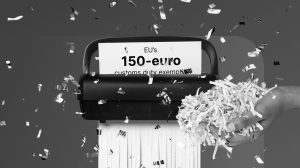
The European Union’s decision to abolish the €150 de minimis customs duty exemption from 1st July 2026 has attracted significant attention across the e‑commerce and trade sectors. At first glance, the change appears to introduce new costs and complexity for UK exporters. However, viewed in a broader global context, it represents something more strategic: a shift toward a more level, transparent, and modern trading system, one that UK businesses can ultimately benefit from.
What is changing and why it matters
From 1st July 2026, the EU will remove the long-standing rule allowing goods valued under €150 to enter duty-free.
In its place:
- A temporary €3 flat duty per item will apply until 2028
- After that, standard customs duties will apply from the first euro under a fully digital customs system
This reform is part of a broader effort to modernise customs, driven by the explosive growth in global e‑commerce and the need for better compliance, fairness, and enforcement.
Consider your shipping terms and conditions:
- If you ship duty paid to customers, services like Royal Mail’s PDDP service will calculate the additional duty(ies) upfront
- If you ship DAP etc. where customers are responsible for duty and VAT, amend your terms and conditions, invoices, communications, etc. to ensure they are aware of the removal of de minimis and the additional flat fee(s)
Reframing the narrative: this is a global shift
While much of the focus has been on the EU, it’s important to recognise that this is not an isolated policy move. It reflects a wider trajectory across global markets.
- Governments are reassessing low-value import thresholds
- Concerns over undervaluation, tax leakage, and product safety are increasing
- Digital customs systems now make it easier to process even low-value goods efficiently
The EU itself highlights that billions of low-value parcels enter the bloc annually, creating enforcement challenges and distorting competition.
The direction of travel is clear: low-value imports will no longer receive special treatment in major economies.
The UK is moving in the same direction
Crucially for UK exporters, this shift is not one-sided. The UK is also reviewing and moving toward tightening or removing its own de minimis treatment for imports. This matters because:
- It signals regulatory alignment in principle, even outside the EU
- It reduces the risk of the UK being structurally disadvantaged
- It reinforces the idea that a new global trading norm is emerging
In other words, what UK exporters are facing in the EU is not a unique penalty, it is part of a global rebalancing of cross-border commerce.
Why this can be positive for UK exporters
1. A more level playing field
One of the biggest advantages of the old de minimis rule was also its biggest flaw: it distorted competition.
- Overseas sellers could ship low-value goods into the EU duty-free
- EU-based retailers had to import in bulk and pay duties
- Many shipments were undervalued to stay below the €150 threshold
The EU estimates that up to 65% of parcels may have been undervalued, creating an uneven market. Removing the threshold helps ensure:
- Fairer competition between domestic and international sellers
- Less advantage for ultra-low-cost, high-volume exporters
- Better conditions for compliant UK brands
2. Reduced competitive pressure from ultra-low-cost platforms
The previous system enabled massive volumes of low-cost goods, often from large non-EU marketplaces, to enter duty-free. With duties now applying to every shipment:
- The price gap between premium UK brands and low-cost imports narrows
- Quality, brand, and service become more important differentiators
- UK exporters with strong value propositions gain relative advantage
3. A push toward smarter, more scalable supply chains
While the reform introduces costs for direct-to-consumer (D2C) shipping, it also encourages more efficient logistics models:
- Bulk shipping into the EU
- Regional fulfilment centres
- Strategic stock positioning
These models can:
- Reduce per-unit costs over time
- Improve delivery speed and customer experience
- Strengthen long-term EU market presence
For ambitious exporters, this is an opportunity to transition from opportunistic exporting to structured international growth.
4. Improved market standards and trust
The EU has raised concerns that a large proportion of low-value imports fail safety and compliance checks. By tightening customs processes, the reform will:
- Increase product compliance
- Reduce unsafe or substandard goods
- Enhance consumer trust in imported products
This benefits UK exporters who already meet high regulatory and quality standards.
5. Futureproofing against global regulatory trends
Because similar changes are emerging globally, adapting now offers a strategic advantage. UK exporters that:
- Build robust customs processes
- Invest in compliance systems
- Optimise international logistics
…will be better positioned not just in the EU, but in other markets likely to introduce similar rules.
Practical implications with a positive lens
Yes, the reform introduces new considerations:
- Duty costs (e.g. €3 per item in the short term)
- More detailed customs data requirements
- Greater operational complexity
But these can be reframed as capability-building investments:
- Challenge: Increased duty costs. Opportunity: Reprice strategically and improve margins through efficiency
- Challenge: More data requirements. Opportunity: Build stronger compliance and reduce risk of delays
- Challenge: Logistics complexity. Opportunity: Develop scalable EU distribution infrastructure
Strategic actions for UK exporters
To capitalise on this shift, UK businesses should:
- Re-evaluate EU market strategy → Move from simple cross-border shipping to structured EU operations
- Optimise pricing models → Factor duties into pricing without eroding competitiveness
- Invest in EU fulfilment → Consider warehousing within the EU to streamline distribution
- Strengthen compliance capabilities → Ensure accurate HS codes, product data, and declarations
- Monitor global developments → Prepare for similar reforms in other key export markets
From friction to opportunity
The removal of the €150 de minimis rule marks the end of an era, but also the beginning of a more mature, balanced global trading system.
For UK exporters, the key takeaway is not simply that costs are rising, but that:
“The rules of international e‑commerce are evolving, and those who adapt early will be best positioned to win.”
With the UK moving in a similar direction and other markets likely to follow, this is not a temporary disruption. It is a structural shift. Businesses that embrace the change, by investing in smarter logistics, stronger compliance, and long-term EU market presence, will find that what initially appears to be a barrier can, in fact, become a powerful competitive advantage.